


Growing the team to take Passivhaus mainstream
Following the UK Passivhaus Conference 2026, the Passivhaus Trust thanks three long-serving Board members, welcomes five new ones, and expands its staff team to meet growing demand for Passivhaus across the UK.
Scaling affordable comfort and resilience was the theme of this year’s UK Passivhaus Conference on 18 November, and it reflects where the sector is heading. The Trust’s goal is for 10% of new UK homes to be built to the Passivhaus standard by 2035, up from around 1% today. Getting there needs more capacity across the industry, and that includes the Trust itself.
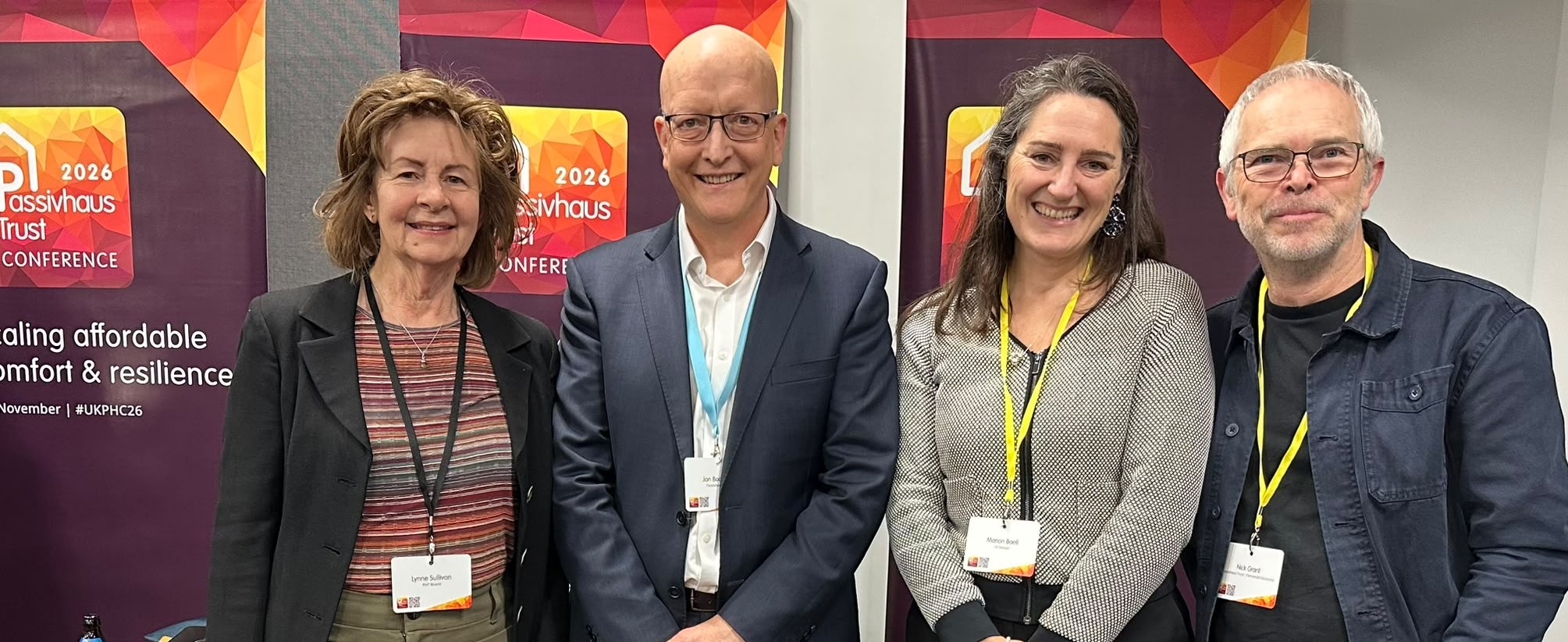
Thank you to the Board members who shaped the Trust
Marion Baeli, Nick Grant and Lynne Sullivan are stepping down from the PHT Board after more than a decade of service.
Marion Baeli's retrofit expertise and skillful Passivhaus communications have offered invaluable insights for the Trust. The Trust has also hugely benefited from Nick Grant's no-nonsense technical leadership, through his role as Technical Director and support of our Technical Steering Group. Lynne Sullivan's policy and advocacy work on a wide range of Government and construction industry panels has been hugely impactful in the mission to mainstream Passivhaus.
All three will be remaining active in the Passivhaus community, and Nick continues as Chair of the Trust’s Technical Steering Group. The Trust is grateful for their enormous contributions over the years, and they have shared some thoughts on what comes next for Passivhaus in the UK.
Nick Grant, Director, Elemental Solutions
“The Trust serves as a focus for a great community of people who really care about buildings and people. On the technical side alone, the membership has been very influential in improving the Passivhaus Standard right from our very first fumbling steps. Moving forward I think we need to embrace radical simplicity without compromising the core principles. Like safe drinking water, comfortable, healthy and low impact buildings need to become the norm, not an aspirational lifestyle statement for the few.”
Marion Baeli, Principal, Retrofit & Adaptive Reuse, 10 Design
"I discovered Passivhaus in 2009 and, like many others, I have never looked back. It changed the way I design for good. Being on the Trust's board for so long has been a privilege and has given me a front-row seat to its amazing evolution into a real voice on policy and a champion of robust, high-quality design. Its future could not be brighter, nor more timely: it proves that comfortable, resilient, energy-frugal homes are achievable today at scale, and that it will help us meet the challenges of climate change, housing and energy security with more confidence."
Lynne Sullivan, Architect & Design Consultant, LSA Studio
"Fifteen years ago, my architectural practice was a finalist in all 3 Passivhaus Prototype competitions - the intention was to showcase Passivhaus at BRE Demonstration sites across the UK - unfortunately only one was built (not ours!). This characterises a time when carbon ratings had only just been introduced into building regulations, and UK designers with Passivhaus capability were as rare as hens' teeth. Now in 2026 it is established as an important benchmark by clients, and award-winners have shown that Passivhaus buildings can hit all the design quality buttons and guarantee high performance and resilience. I am honoured to have served on the PHT Board during this evolution, and we must continue to evidence how Passivhaus buildings exemplify whole life value in a world where scarce resources need to be spent wisely."
Welcome to our new Board members
Five new Board members were announced at the conference, bringing experience across cost management, consultancy, engineering and contracting.
 |
Dr Dean Carrick, Practice Manager, Cost & Commercial, Scotland, AtkinsRéalis“Despite being a QS, I see Passivhaus first and foremost as a quality standard and it is fair to say that there are times when “quality costs”, inevitably. But with clear expectations established early and understood collaboratively by the client, design team and supply chain, better decision-making, reducing unnecessary design development and change, can improve quality and performance while creating opportunities for cost efficiency, i.e. building form and standardisation. I believe the greatest impact in accelerating the adoption of Passivhaus will come from closing the perceived gap between long-term (whole life) performance and affordability. If we bring design, cost and delivery thinking together from the outset, and share better evidence on actual cost and performance, we can make Passivhaus a much easier “value” choice for clients.” |
 |
Sally Godber, Director, WARM & Coaction“Passivhaus offers a lot of benefits, but currently costs more than business as usual; this must narrow for Passivhaus to mainstream. The situation is already changing as we see the benefits of it happening at scale in certain areas: contractors are coming with experience, they’re not scared of delivery and they know how to optimise for cost and risk. The audit process of Passivhaus certification stands out as a major benefit that other areas of construction could learn from. The benefits are wide ranging: the team’s work gets reviewed and feedback provided so they are continuously improving; quality expectations are clear and will be checked so contractors cost on the same basis; and of course the building achieves the performance outcomes that are needed.” |
 |
Nicola Jackson, Group Net Zero Projects Lead, Robertson Group"Passivhaus needs to be mainstreamed in the UK to deliver a more resilient built environment. We should not accept underperforming buildings that are susceptible to poor indoor air quality, overheating and excessive energy use, especially as we are in a climate emergency and a cost-of-living crisis. I believe that to accelerate adoption of Passivhaus standard, we need to increase post occupancy evaluation to assess and optimise the performance of buildings. Passivhaus can address the performance gap that is common across our built environment, to ensure our buildings are long-term assets rather than a burden on cost and the climate." |
 |
Samantha McCabe, Sustainable Buildings Lead Scotland, WSP"For me, Passivhaus is about closing the gap between design intent and real-world performance, creating buildings that are genuinely lower energy, comfortable and resilient. The real step-change will come when verified performance influences value and finance, giving developers and investors a compelling commercial reason to deliver better buildings."
|
 |
Jasper Meade, Director, PYC Group"We have success in a wide range of Passivhaus buildings in the UK covering all sectors, through a program of post occupancy evidencing demonstrating the benefits it gives, we now need to strengthen the marketing of the story. Setting Passivhaus as a standard that can be used as an alternative for SAP and EPC will reduce overall building certification costs to users and encourage take up. Successful repetition will demonstrate the performance benefits, with building costs reducing each time. Legislation can follow."
|
Growing the staff team
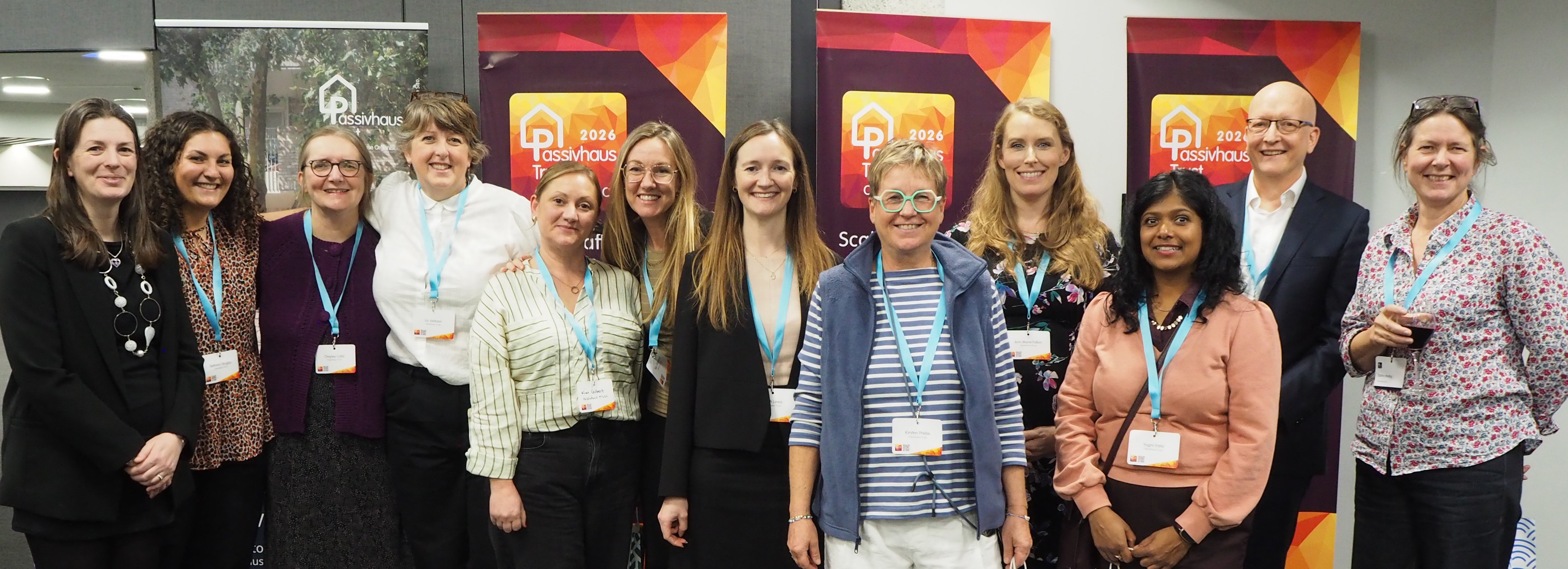
The staff team is growing too. New roles in research and policy, digital and events, and business development will strengthen the evidence behind Passivhaus, extend the reach of our events and online learning, and widen the support we offer clients and members. We’ll introduce new colleagues here as they join over the coming months.
Architect and Passivhaus Designer Louise Charlton joins as Interim Development Director, covering for Ann-Marie Fallon during her maternity leave.
Get involved
Missed the conference? Session recordings will soon be available via the Passivhaus Learning Hub. To support the Trust’s work and connect with the people driving Passivhaus forward, find out about membership.
Further information
18th November 2026
Get involved with the UK Passivhaus community
 |
 |
 |
 |


